Saturday, November 12, 2011

Theyyam, teyyam


Teyyam, Theyyam


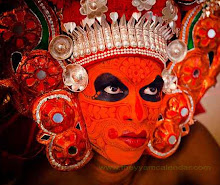
Theyyam, one of the popular folk traditions in North Malabar of Kerala, is famous for its vividness, and passion of people, and it is admirable in nature. The Teyyam or Teyyattam is a popular cult in Malabar which has become an inseparable part of the religion of the village folk. As a living cult with centuries-old tradition, ritual and custom it embraces almost all castes, classes and divisions of Hindu community in this region.

Teyyam is a magico-riligious observance. It is highly conditioned by myth. Such is the nature of theyyam and its powerful consequences. The very word teyyam brings forth in the mind of a listener an enchanting and beautiful picture. Nevertheless, in the case of the people of North Malabar, the word has more than one meaning . It is an indispensable part of their religion, and they observe it as their guide and protector. The believers who hold its ire bear woes and its blessing gifts for their well being. There are male and female teyyams. According to their nature, and myth in particular, it is possible to classify teyyams into different types namely, teyyams of God and Goddess, Ancestors, Heroes and Heroines, Spirits and Devils, and Nature or Animals. More details pls visit www.theyyamcalendar.com

Teyyam, theyyam


Theyyam Festival in Kerala

Theyyam, the spectacular ritual dance widely performed in north Kerala, has its distinct forms of visual and verbal expression. However, what was once expressed through the distinctly indigenous forms of this religious "other" no longer remains the same, as the specificities of meaning and messages as encoded in the whole structure of its ritual performance were leveled out and superseded by ideological laundering of caste Hinduism. RITUAL AS IDEOLOGY looks into the specific cultural formation of teyyam -- it re-frames and interprets various myths of the mother-goddesses and hero-deities by situating them in the historical conditions in which they originated.
Based on a study of the myths at a micro-structural level, the book explores from a sociological perspective how the ritual functions as ideology, apart from its cultic or religious significance. The study also unfolds and explains the gender disparity between the archetypal Female Devourer and her Male Victims, the recurrent motifs in the myths related to various manifestations of the Terrible Mother in theyyam. The study thus acquires contemporary significance in the face of cultural authoritarianism that in its design of appropriation attributes the village pantheon of every "little tradition" to canonical Hinduism, a process that has been so rife in today's cultural politics.

Wednesday, November 9, 2011

Theyyam Timings


Theyyam Timings

The Malayalam day Thulam 10, ( October 27, 2009 ) Malabarians celebrate as ‘Pathamudayam’. The day has immense importance in North Malabar as the day ensures self sufficiency of the agricultural crops and sound wealth and health of the common people. Almost all the sacred shrines in North Malabar are performing certain poojas and rituals during the occasion to appease their God and Goddesses. More over the shrines like Kavu, Kotam and certain temples are starting their open ceremonies for the season to welcome their living God ‘Theyyam’. This particular day is called ‘Pathamudayam’ and the function performed during the day is generally termed as ‘Puthari Ulsavam’. This is the starting day of the Theyyam performance in North Malabar. Most of the Kavu and shrines perform half make up theyyam called ‘Vellatam’ and original full make up theyyam will perform later during the calendar date. The Chathampalli Kshethram in Kattamballi performs the first theyyam kaliyattam during the season and Vishakandan theyyam is famous here. For more details pls visit www.theyyamcalendar.com

Theyyam


THEYYAM KERALA

Theyyam is a method of demonstrating the supernatural, the spirit world, inhuman powers, gods and goddesses, and bringing them into the human world through the vehicle of specified people who are born into this role. These individuals achieve these feats by dressing in the intended form of the desired effigy and performing rites and rituals that have been prescribed by their ancient traditions. These traditions have been passed down, and have developed, over centuries and centuries. The theyyam performer usually begins with propitiating the god they wish to manifest. After specified rituals are performed, including thottam (invocation), singing about the life of the god, and dancing, the performer enters a trance state and becomes possessed by the god. Acting as a vessel for the god, the performer now becomes an oracle. As a physical embodiment of the god, the audience worship the performer who in turn showers them with blessings. In addition, he is an oracle so people often ask the deity various questions about their lives, about the future, and ask for help, boons, and general welfare.

Tuesday, November 8, 2011

Theyyam Festival


THEYYAM FESTIVAL


Theyyam , a colourful ritual dance of Kerala that attributes great importance to the worship of heroes and ancestral spirits, is a socio-religious ceremony. The Theyyam festival usually held in from October to May every year. The colourful pageantry, the enthusiastic crowd and the religious favor are all worth witnessing. Every village in North Kerala was bound to perform it in connection with the local shrine (Kavu). Theyyams are performed before the shrines. This sacred dance is believed to bring about well being for the society and the family. Theyyam also called Kaliyattom, presents divine forms as well as heroes from history and myth. Each Kolam has very stylized and specific forms, each with its own specific representative as pat. The awe inspiring features are painted with craftsmanship and artistry which by itself, is a unique tradition. Many of the Kolams take 3 to 5 hours to prepare. The figure of each Kolam is bound by the rules and structures laid down by tradition. Each Kolam also has very special colours, crown , headdress, breastplates, arm ornaments, bangles, garland, woolen or cotton garments. They are all elaborately furnished and singularly shaped.

Theyyam


Theyyam

Theyyam is one of the oldest, indigenous and mystic ritual art form of Kerala, India. Its roots can be traced back to over 2000 years ago, and still preserves its tribal and Dravidian features although the art form has evolved over centuries to form what can be called an amalgam of religious and spiritual traditions. It is now practiced in the land of Kolattunadu (The land of the Kolathiri), the northern part of Kerala. This region today stretches from the northern parts of Kozhikode district to the Kasargod district. Etymologically, the term ‘Theyyam’ comes from the Sanskrit word for god, ‘Daivam,’ meaning God. What separates Theyyam from other performing arts is its ritualistic nature itself. It is a phenomenon of cultural, spiritual and artistic significance. More than 400 Theyyam forms depicting various deities exist in this cult that has become the cultural symbol of north Kerala.